Issue 02 · Doha · Landmark · Doha Corniche
Museum of Islamic Art
Cream limestone and jet-mist granite, on an island made for the building.
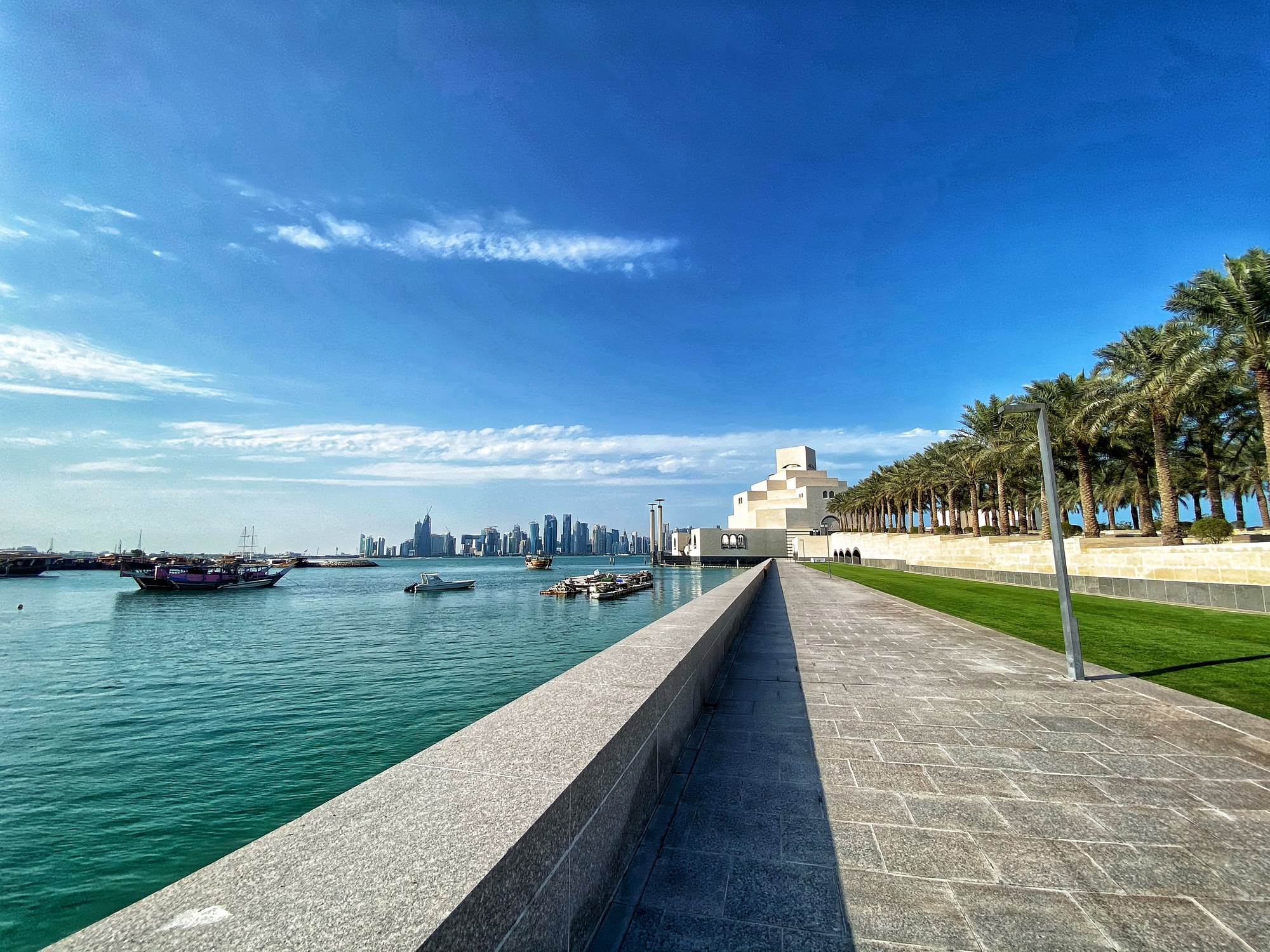
The Museum of Islamic Art stands on a purpose-built island off Doha’s Corniche, a site I. M. Pei asked for so that the building would keep its presence as the city grew. It was his first and only project in the Middle East, and is widely described as his final major work; he came out of retirement to take it on. The museum was inaugurated on 28 November 2008 and opened officially to the public on 1 December 2008.
Pei clad the building in cream-coloured limestone from France and jet-mist granite from the United States, a geometry he traced to Islamic architecture and, above all, to the ablution fountain of the Ibn Tulun Mosque in Cairo. A five-storey main building and an education wing meet across a courtyard. Inside, a high domed atrium holds a curved double staircase and a circular metal chandelier; an oculus at the top of the faceted dome captures and reflects patterned light, and a 45-metre window on the north side opens to the bay. Pei recommended Jean-Michel Wilmotte, with whom he had worked at the Louvre, to design the interior spaces and the museography. “It is the light of the desert,” Pei said, “that transforms the architecture into a play on light and shadow.”