Issue 03 · Dubai · Chapter
Interiors
Two interiors that carry the issue’s argument indoors: a street of warehouses at Alserkal Avenue, in which OMA’s Concrete was the first building the practice completed in the UAE, and Etihad Museum’s scroll of pale panels closed around Union House. Each is open to visitors.
Palettes marked “documented” name materials described by the venue, its designers or the press; those marked “editorial impression” are our reading of described colours.
Arts neighbourhood · Al Quoz
Alserkal Avenue / Concrete
A street of warehouses under shade sails, and OMA’s first completed building in the UAE.
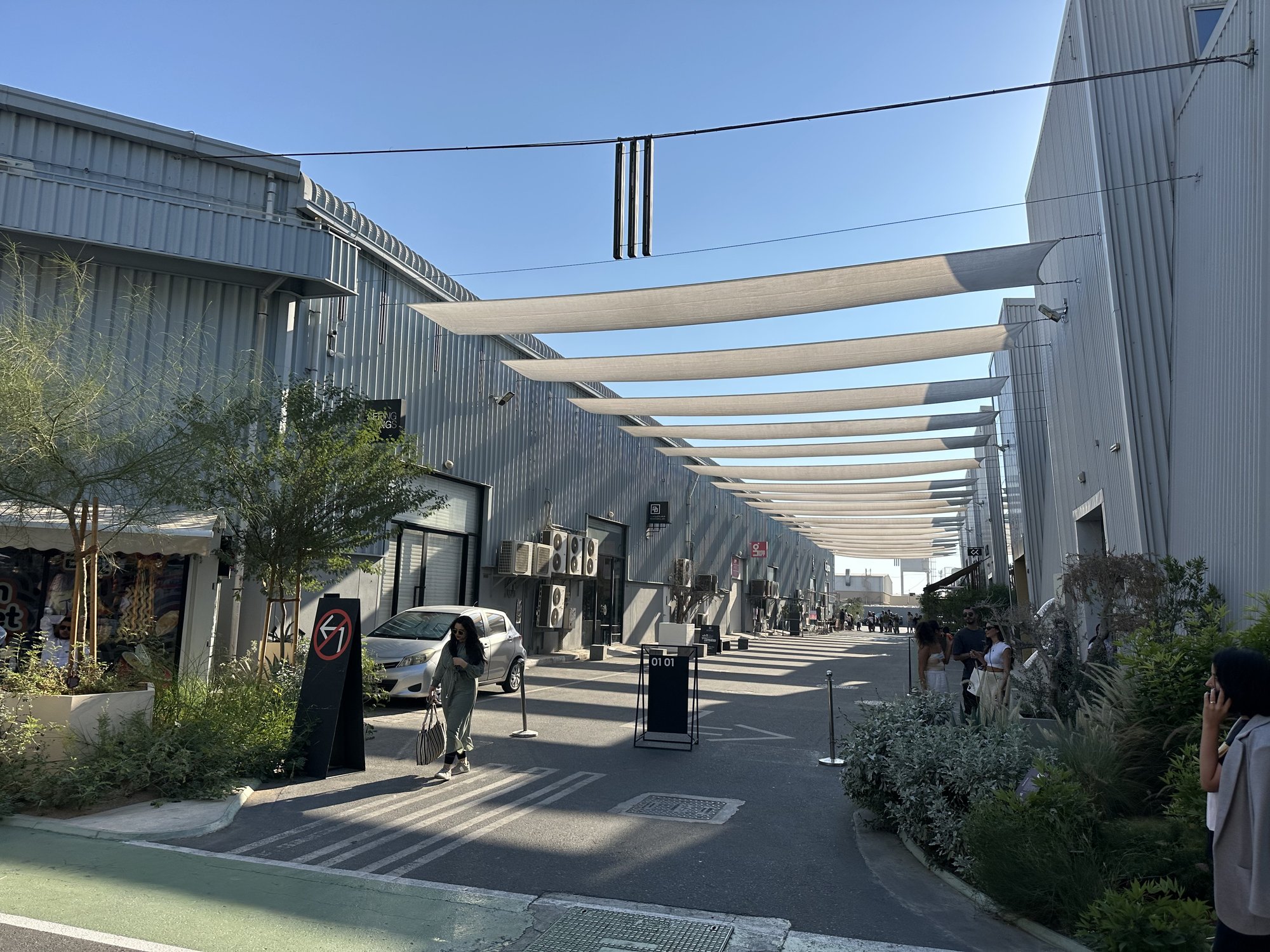
Alserkal Avenue, in Al Quoz, was established in 2007 and is described by its own organisation as the region’s foremost arts and culture neighbourhood: a community of galleries, alternative spaces, and design, media and industrial studios, later joined by a programming arm and a residency. The photograph used here is of that Avenue — a street of grey warehouse façades under rows of canvas shade sails — not of a single building.
Within the Avenue, Concrete opened on 16 March 2017 as the first project in the United Arab Emirates completed by OMA, the Office for Metropolitan Architecture founded by Rem Koolhaas. Alserkal’s inaugural press release, and OMA partner Iyad Alsaka, describe a collection of warehouses conserved and reimagined: a 600-square-metre, double-height, multi-purpose room with movable walls and a translucent façade that can open the interior to the street. Rem Koolhaas, at the opening, said the work was not the introduction of a new shape but an infiltration of an existing building by an arts institution, “totally produced in Dubai.” Interior design and engineering were completed by Dubai-based companies. No official still of Concrete’s own façade was used in this issue, because none could be clearly taken from OMA or Alserkal with a visible credit; the Avenue photograph stands for the neighbourhood in which Concrete sits.
Museum · Union House
Etihad Museum
A scroll of pale panels and glass, closed around the house of the union.
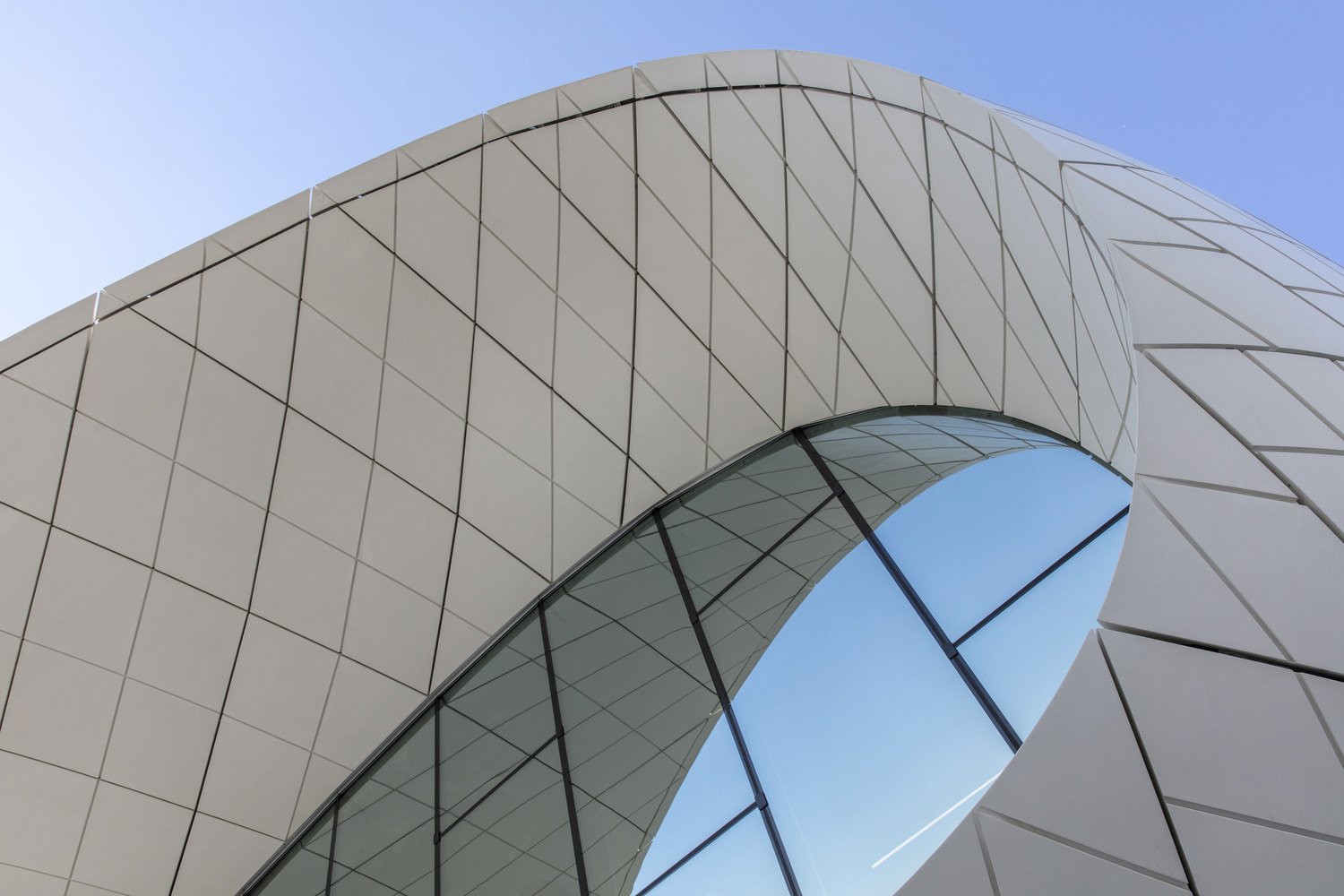
Etihad Museum was designed by Moriyama Teshima Architects and is integrated with the historic Union House on Dubai’s waterfront. The architects describe a parabola-shaped pavilion and a subterranean museum, a scroll-like form that “mimics the parchment paper of the Constitution,” with an entrance of bronze metal text that cites the nation’s founding philosophy. They date the project to 2016. The museum tells the story of the founding of the United Arab Emirates from that house and from the new rooms around it.